
Largs Probus Club Members were amazed to find out that a thriving astronomy group, Inverclyde Skywatchers, meets weekly just up the road in Inverkip. Our presentation was by the founder of the Skywatchers group, Marion McNeill. She outlined how the group was set up and is now recognised as one of the leading, active, astronomy groups in the country.
In 2012, Marion had a hip replacement and then was at a loose end as to what to do. She heard about a beginners’ astronomy course being run for 6 weeks by Inverclyde Council, so she signed up and absolutely loved it. She enquired whether there would be a follow up, only to be told that it would be repeated. So, she and some of the other attendees signed up again. There were no plans for another series, quite disappointing, considering the enthusiasm of those who had attended.
Typical of Marion, something had to be done: an independent course. Greenock South West Library agreed to them continuing to use the room they had been meeting in and Inverclyde Skywatchers was born on 20th April 2015. Then came the problem of how to run it, there needed to be a constitution, office bearers and a programme – could it continue to meet weekly? (Note: it is a group, rather than a club.) Other similar groups seemed only to meet monthly. By going to other astronomical meetings with her friend and colleague, Margaret Lees, they managed to put their programme together.
The group meet on Monday afternoons, 3.00 – 5.00 in Inverkip Hub, a total of 30 meetings a year. They attend festivals, schools, Scouts and through Inverclyde Regeneration have started a group for young people, meeting monthly. Having had Prof. Dr Alexander MacKinnon come to speak, he agreed to help run the group, so it is now run by Marion McNeill and Dr Alexander McKinnon. Note: Alec MacKinnon has spoken twice at Probus: Physics and Ben Nevis and Why is the Sky Dark at Night?
In 2018, the group was asked to host the British Astronomical Association 2019 1-day meeting – a great honour. It was held in the Beacon Centre in Greenock. Following the success of that meeting they also hosted the BAA Spring Event in 2024.
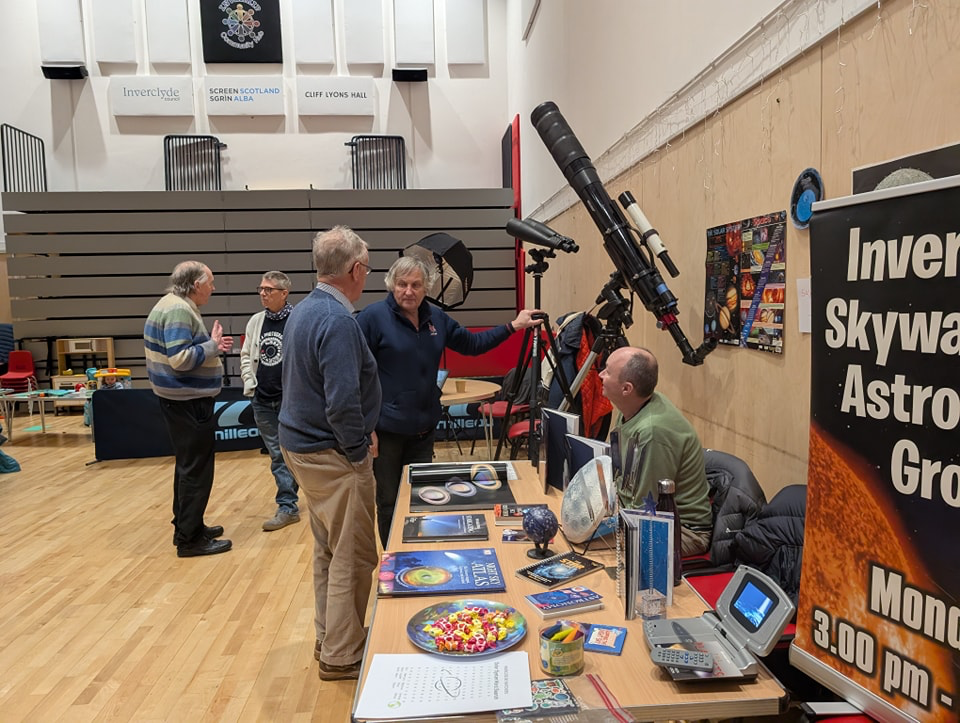
Marion said “We have great in-house speakers and we have had amazing speakers from all over the UK, which have included the famous Prof. Dame Jocelyn Bell Burnell DBE FRS FRSE FRAS (discoverer of Radio Pulsars) and Prof Martin Hendry MBE (Professor of Gravitational Astrophysics and Cosmology at the University of Glasgow), to name a couple.” The group have been on various trips, attended talks and presentations and had the pleasure of attending a presentation from NASA’s Assistant Division Chief Sarah Murray and Astronaut Steve Bowen, who has missioned to the International Space Station, walked in space and circled the earth many, many times. After meeting Steve, Marion said, “It was amazing standing right next to Steve and I actually had my right arm around the waist of the only man who has flown in the International Space Station three times and I have the picture to prove it.” He was so nice and so down to earth!” she laughed.
Speaking more personally, Marion won the Sir Patrick Moore Award, named after Britain’s most famous astronomer, for her incredible achievements at a grassroots level. She was hailed by the British Astronomical Association as ‘a dynamic presence’ who has brought together a ‘vibrant community of local astronomers’. During an emotional acceptance speech Marion paid tribute to the impact astronomy has had on people’s lives and the achievements of all the members of her group in Inverclyde. “I have always had such a passion for astronomy and I love the Inverclyde Skywatchers. It makes me appreciate how wonderful the earth is and its place in the solar system. “Inverclyde Skywatchers is my happy place and I love organising all the events and coming up with ideas.
Marion ended by explaining about The System for Capture of Asteroid and Meteorite Paths (SCAMP) which is the UK component of the FRIPON network (Fireball Recovery and InterPlanetary Observation Network). The FRIPON project has been designed as a real-time network with the aim of triggering a field search within the 24 h that follow the fall in order to recover fresh meteorites. The first Scottish SCAMP camera was installed and commissioned in Gourock in April 2025 by Marion.
Finally, she challenged us with the final picture taken by Voyager 1 space probe from an unprecedented distance of over 6 billion kilometres (3.7 billion miles, 40.5 AU), as part of that day’s Family Portrait series of images of the Solar System. The Pale Blue Dot is a photograph of Earth taken on February 14, 1990, by the Voyager 1 space probe from an unprecedented distance of over 6 billion kilometres (3.7 billion miles, 40.5 AU), as part of that day’s Family Portrait series of images of the Solar System.
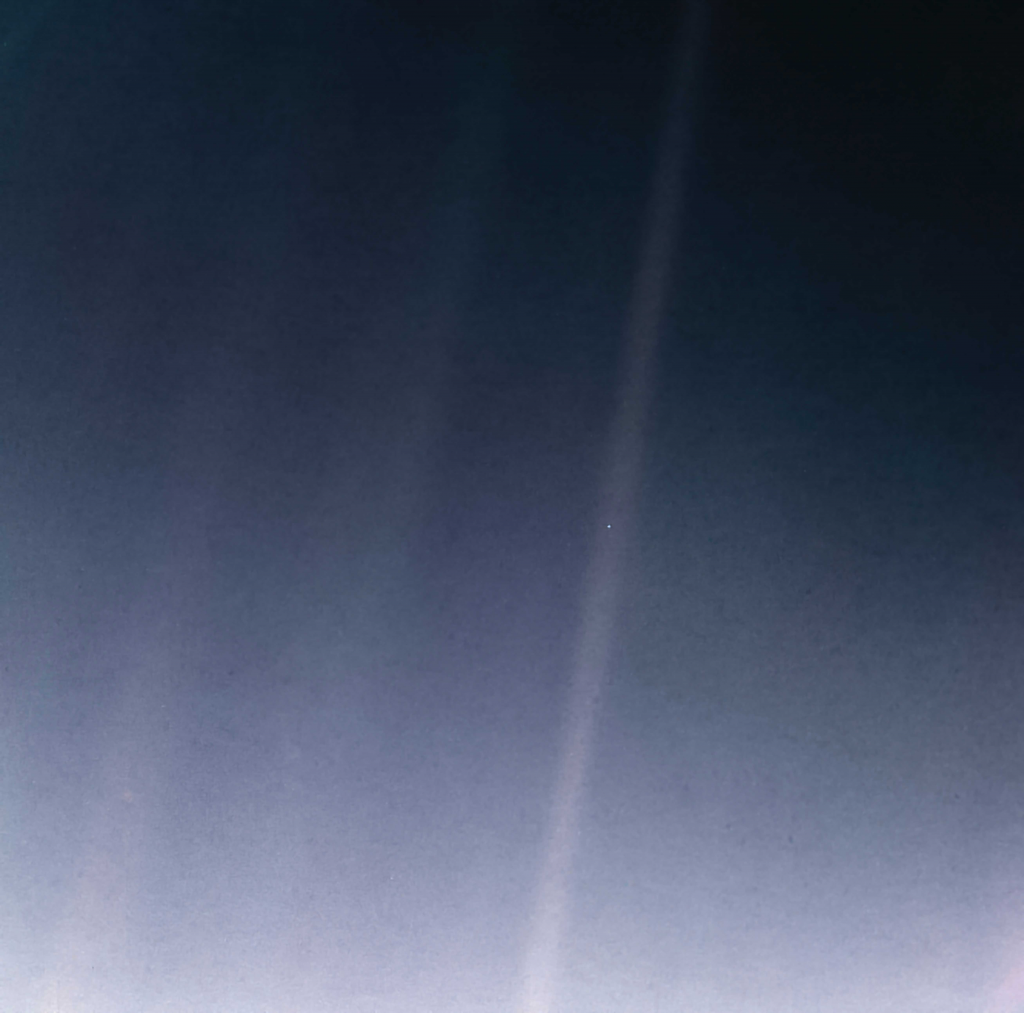
In the photograph, Earth’s apparent size is less than a pixel; the planet appears as a tiny dot against the vastness of space, among bands of sunlight reflected by the camera.Yes, that’s it, just to the right of centre! This gives rise to questions such as: Are we the only inhabited planet in the universe? Do UFOs exist? Why do humankind fight with each other and jeopardise the future of the planet by global warming? There are so many questions for a unique dot in the universe!
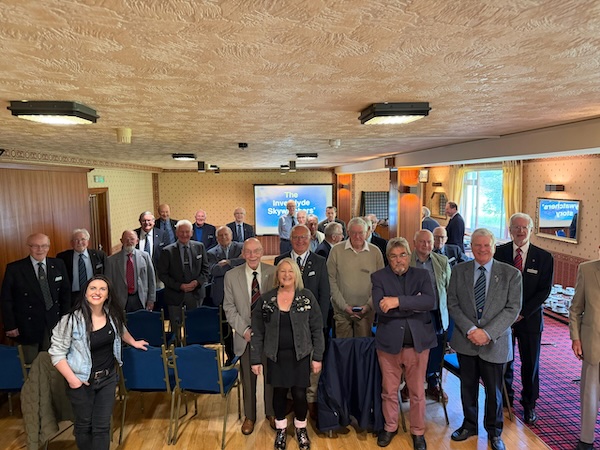
Club members after the Skywatchers talk.
Why not join us at our next meeting?
New members are always welcomed at the Club. If you are 50 or over, retired, or nearing retirement, (men only, I’m afraid, sorry ladies) you can attend three meetings as a guest and find out what a relaxed and friendly time we have. That’s plenty of time to decide whether to become a Club member or not. Please check out our programme and fill in our Contact Form if you wish to attend as a guest, or to enquire about joining.
Largs Probus Club will next meet in the Willowbank Hotel on Wednesday 27th May at 10am when Shelagh McLachlan will give a talk on the Alloway Railway Tunnel.